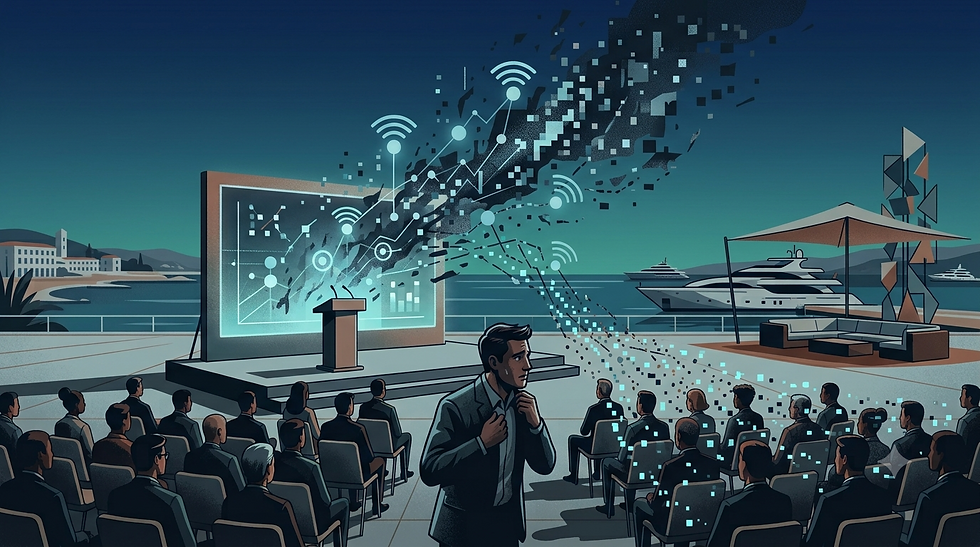
Is DOOH Built for Reach—or for Remembering?
Updated: Jun 7

Digital out-of-home (DOOH) is evolving fast. Bigger screens, better creative tooling, more sophisticated reporting. But the planning model hasn't kept up. We still talk like every "impression" equals a moment of real attention.
That gap matters—because DOOH doesn't primarily have a measurement problem. It has an attention problem.
Impressions vs. Reality
Most DOOH is still bought on reach, frequency, and impressions. Useful planning metrics—but they sidestep the question your CFO (and frankly, your buyer) cares about: Did someone pay attention?
In high-density environments—subways, city streets —you're not competing against one other message. You're competing against dozens of screens, physical movement, and the most dominant screen of all: the phone.
So yes, a plan can show millions of impressions. But many of those are partial (seen out of the corner of an eye), fragmented (interrupted by movement or rotation), or simply lost to the phone. "Delivered" is not the same as "seen."
When the Creative Promise Breaks
DOOH introduced the idea of sequential storytelling, multi-screen narratives, dynamic messaging. The catch: all of that assumes sustained attention across time and space.
In practice, screens rotate, inventory is shared, and sequences break. A corridor sequence that looks perfect in a deck can fall apart on the wall. As seen in the example below, two panels tell the beginning of a story, the third is entirely different and irrelevant. What was meant to build into something memorable becomes a disconnected set of visuals with no payoff.

The format is sold on its storytelling potential. The environment rarely cooperates.
More Screens, Less Attention
In high-density placements, everything is animated, everything is bright, and everything is trying to be seen. The result isn't engagement—it's overload. When every message is loud, nothing stands out long enough to matter.
More inventory doesn't create more attention. It fragments it.
Measurement Is Improving—But Answering the Wrong Question
The industry has made real progress: mobile location data, cross-device attribution, exposure modelling. But most of it still answers "Was someone near the ad?"—not "Did this influence behaviour?"
So brands end up with cleaner dashboards and more data, but not more clarity. Better reporting on a fundamentally flawed assumption isn't a solution.
What DOOH Actually Is
What it is:
A mental availability channel
A credibility signal in the physical world
A reinforcement layer for digital media
What it isn't:
A precision performance channel
A reliable storytelling medium
A guaranteed attention capture mechanism
That's not a knock on the format. It's just an honest description of what it does well—and where it gets oversold.
The Dugbe Principle: Optimize for Cognitive Impact, Not Media Delivery
Assume the viewer gives you two seconds, max. Assume they see one frame, not a sequence. Assume they're half-distracted.
If your message doesn't land under those conditions, it doesn't work—regardless of how premium the placement is.
What that looks like in practice:
Design for one frame. The viewer sees a single moment. Not your sequence.
Win in two seconds. Brand and message legible instantly, at distance, in motion.
Reduce cognitive load. Fewer words, fewer elements, higher contrast, clear hierarchy.
Plan for repetition, not narrative. Consistent assets across placements build memory over time. Sequences don't.
Measure what you can defend. Treat exposure as a proxy. Validate impact with lift tests, geo holdouts, or matched market comparisons where possible.
When DOOH Makes Sense
Lean in only if:
You have strong digital fundamentals already
You operate in dense, repeatable geographies
You're using it to amplify your strategy—not carry it
The Bottom Line
The industry talks about bigger screens, better targeting, smarter measurement. But keeps missing the most important constraint: human attention is limited, fragmented, and uncontrollable in the real world.
Until brands plan for that reality, DOOH will keep overpromising in strategy decks—and underdelivering in practice.
If you plan DOOH like it's digital—optimizing for delivery and dashboards—you'll keep shipping campaigns that look successful on paper and feel invisible in the world. The better approach is simpler: plan and create for the two-second glance, then use measurement to validate impact you've earned.
Ran DOOH recently? What worked—and what didn’t? Send us your biggest learning.
— Dugbe
Disclaimer: This post was refined with the help of AI tools for clarity and structure. The thinking and perspective are entirely ours. We use tools thoughtfully. We still think for ourselves.